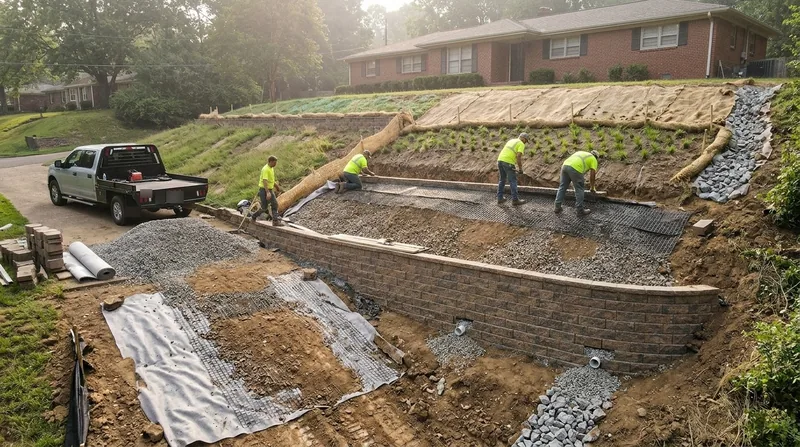




Slope Stabilization & Erosion Control in Memphis: Holding the Bluff Line
Memphis sits on the Chickasaw Bluffs, where deep wind-blown loess silt caps clay and drops into ravines and creek channels feeding the Wolf River, Loosahatchie, and Nonconnah bottomlands. That geology makes Slope Stabilization & Erosion Control in Memphis a year-round concern, not a seasonal chore. One saturating spring thunderstorm can turn a stable loess bank into a slump that undermines a driveway, a patio, or a foundation wall on a cut-and-fill lot in Cordova or Germantown.
We build terraced walls, install geogrid reinforcement, and set erosion control blankets and drainage so water leaves the slope instead of soaking it. If your bank is already moving, start with leaning and collapsed wall repair before the movement reaches the house. Call (901) 519-2101 and we will look at the slope, not just the wall.
Homeowners across Victorian Village, Cooper-Young, Central Gardens, East Memphis, Whitehaven, Frayser, Bartlett, Collierville, and Arlington call us when a ravine edge creep, a creek bank undercut, or a bluff-top yard starts losing ground after heavy rain.
Why Loess Bluffs and Ravine Edges Fail in Memphis
The dominant failure here is loess erosion and slump when saturated, compounded by clay that swells and shrinks through long humid summers. Loess holds a near-vertical cut when dry, then loses strength fast when water infiltrates, which is why so many Memphis slopes look fine in August and collapse in April. Add torrential spring thunderstorms and a high water table in the Wolf River bottomlands, and you get the undercut banks and bowed walls we see weekly.
- Loess silt erodes and slumps when saturated, pulling the toe out from under existing walls.
- Expansive clay swells against wall backs and pushes poorly drained structures outward.
- Spring downpours overwhelm downspouts and surface flow that was never redirected off the slope.
- Ravine and creek edges in East Memphis and Whitehaven undercut footings during high-water events.
- Cut-and-fill lots in Cordova and Arlington concentrate runoff at the fill slope behind the house.
Every one of these failure modes is a water problem first and a wall problem second, so we treat drainage as part of stabilization, not an add-on.
Key info: A homeowner in Germantown watched a 6-foot loess bank behind the garage slump about 14 inches after a two-day spring storm. The wall was fine. The missing piece was surface diversion and a drained toe, which is exactly what a stabilization plan addresses.
For official guidance on grading, drainage, and when a retaining structure needs a permit, check the City of Memphis building department. Thresholds vary by jurisdiction, and we confirm them before any work starts.
How We Stabilize a Memphis Slope, Step by Step
We start by reading the slope the way it actually behaves: where the water enters, where the toe is losing material, and what sits above the failure line. On bluff and ravine lots, that often means the fix is a terraced wall system with geogrid, not a single taller wall. We size the structure to the soil and the surcharge, then build the drainage that keeps it dry.
- We walk the slope and mark the failure zone, the water entry points, and any structure within the influence area.
- We test and classify the soil, because loess, clay, and bottomland fill each demand a different reinforcement approach.
- We design the terrace heights and setbacks, then specify geogrid layers and drainage behind each wall.
- We install subsurface drainage and redirect downspouts and surface flow away from the slope face.
- We build the walls, compact in lifts, and seed or blanket exposed soil to stop surface erosion.
- We verify the finished grades and give you a simple maintenance plan for the next rainy season.
The result is a slope that sheds water instead of absorbing it, with a wall sized for the load it actually carries.
Key info: On a ravine-edge lot in Collierville, we terraced a 9-foot drop into two 4-foot block walls with geogrid and a French drain at each toe. The homeowner kept the yard, the fence line held, and the bank stopped creeping toward the patio.
If your slope drains poorly, the retaining wall drainage work is the part that makes the stabilization last.
Stabilization Methods We Use on Memphis Slopes
No single method fits every bank. A loess bluff cut, a creek-bank undercut, and a suburban fill slope in Lakeland each need a different combination of structure, reinforcement, and drainage. This table shows how we match the approach to the site.
| Approach | Description | Best for |
|---|---|---|
| Terraced retaining walls | Two or more shorter walls stepped up the slope to reduce load on any single face. | Tall loess banks and ravine edges where one wall would be too high. |
| Geogrid reinforcement | Layered mesh ties the wall back into the slope soil to resist overturning. | Segmental block walls above 4 feet or carrying a surcharge. |
| Surface water diversion | Swales, berms, and downspout extensions move runoff off the slope face. | Cut-and-fill lots in Cordova, Arlington, and Bartlett. |
| Subsurface drainage | French drains and toe drains relieve hydrostatic pressure behind walls. | Bottomland sites and any wall showing bowing or seepage. |
| Erosion control blankets and seeding | Temporary and permanent cover holds exposed loess until vegetation establishes. | Freshly graded slopes and creek banks after repair. |
Slope Stabilization & Erosion Control Cost in Memphis: What to Expect
Every stabilization job starts with a free estimate, because the price depends on the slope, not on a square-foot formula. A short ravine-edge repair with drainage can be a modest project, while a tall loess bluff with terraced walls and geogrid runs into serious structural work. We give you a real number after we see the water path, the soil, and the access.
Cost moves with wall height and total face area, how much excavation the slope needs, whether geogrid is required, and how far equipment has to travel from the street. Tight rear yards in Midtown and Central Gardens add handling time. Proximity to a foundation, driveway, or pool raises the engineering and care level. Emergency work after a storm carries its own premium.
Get two or three estimates and compare scope, not just price. A low bid that skips drainage or geogrid is not a cheaper job, it is a shorter-lived one. Our pricing overview shows how the ranges break down.
Hiring a Retaining Wall Contractor Near Me in Memphis: What to Check
Slope work fails slowly and expensively when it is done wrong, so vet the contractor before you sign. Ask for the license and insurance certificate, and confirm the policy covers structural and excavation work, not just general labor. Call references on jobs similar to yours, especially tall walls or ravine repairs.
Ask who pulls the permit. Many jurisdictions require one for walls above roughly 4 feet from the footing, or when the wall supports a driveway or structure, and engineered drawings may be required for tall or tiered walls. Setback and property-line rules apply too, so verify with your local building department. If you are in an HOA, get the architectural approval in writing before excavation starts.
Reach out through our contact page to schedule a free estimate. For homeowners in specific neighborhoods, the Germantown slope stabilization page covers local conditions in more detail.
Slope Stabilization & Erosion Control in Memphis: Pricing Guide
| Service | Price | Details |
|---|---|---|
| Slope inspection and stabilization plan | Free estimate | On-site slope and drainage assessment with a written scope and no obligation to book. |
| Ravine edge or short bank repair | Starting at $2,800 | Includes drainage correction and erosion cover; height and access drive the final number. |
| Terraced wall system with geogrid | Starting at $9,500 | Multiple wall faces, reinforcement layers, and toe drains; total face area sets the range. |
| Bluff or creek bank stabilization | On estimate | Requires soil review and engineering for tall or tiered walls before pricing. |
| Travel | Included | In Memphis and surrounding areas, no separate call-out or mileage fee. |
| Estimate | Free | Response within 24h at (901) 519-2101, no obligation to book. |
Indicative pricing, the exact cost depends on square footage, finish, and site access. Free personalized estimate within 24h at (901) 519-2101.


