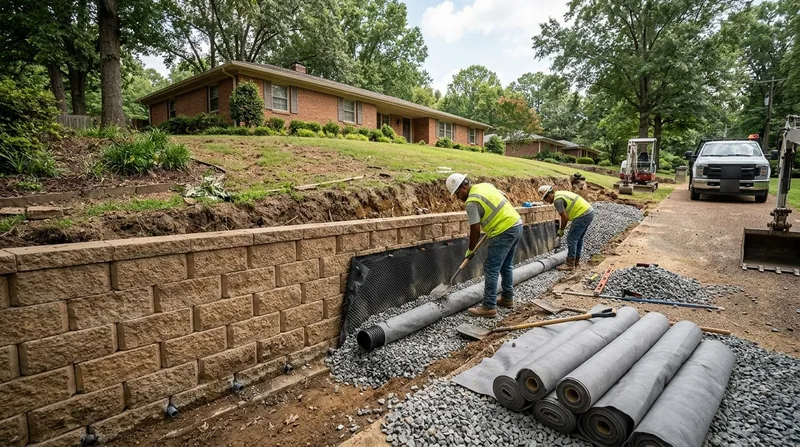




Memphis sits on the Chickasaw Bluffs, where deep wind-blown loess silt caps clay and steep ravines cut down toward the Mississippi. That soil holds water like a sponge during spring thunderstorms, then swells and slumps, and it is the reason so many walls along driveway cuts in Central Gardens and East Memphis start to lean. Proper Retaining Wall Drainage in Memphis is not an add-on. It is the difference between a wall that stands for decades and one that bulges after two wet seasons. We design and install French drains, weep holes, gravel backfill, and waterproofing that move water away from the wall instead of letting it push. If your wall already shows movement, start with our leaning and collapsed wall repair service before the damage spreads.
Why Drainage Decides Whether a Memphis Wall Survives
Hydrostatic pressure is the number one killer of retaining walls in this city. Loess and expansive clay trap rainwater behind a wall, and the saturated soil pushes with enormous force. Add torrential spring storms and long humid summers, and a wall with no relief path fails fast. We see it most in older brick ranches across Whitehaven and Frayser, where railroad tie terraces were built with no drainage at all.
- Saturated loess loses strength and slumps, which rotates the wall face outward.
- Clay swells against the back of the wall and cracks mortar joints and block courses.
- Water finds footing soils and undermines the base, causing settlement and tilt.
- Walls on ravine edges above Nonconnah and Wolf River bottomland face a high water table that never fully drops.
- Skipped weep holes and clogged gravel let water pond behind the wall for months.
Every one of those failure modes is preventable with a drainage system designed for the actual soil on your lot.
Key info: A poured concrete wall on a bluff cut in Chickasaw Gardens can look solid and still be holding a bathtub of water. Weep holes that weep nothing are a warning sign, not a decoration.
For official guidance on walls and grading, check the City of Memphis building department resources before you start any structural work.
How We Build Drainage That Actually Relieves the Wall
We start by reading the site: slope, soil, water source, and how the wall was built. Then we open the backfill, correct the grading, and install a system that gives water somewhere to go. We work on poured concrete, CMU, segmental block, fieldstone, and timber walls across Memphis and the suburbs.
- We excavate the backfill behind the wall to expose the footing and the drain zone.
- We install perforated French drain pipe at the footing, wrapped in filter fabric and set in washed gravel.
- We core or clear weep holes at the base of concrete and CMU walls so water exits the face.
- We place a gravel drainage column behind the wall and cap it with filter fabric to keep silt out.
- We waterproof the wall face where soil contact and hydrostatic load are heaviest.
- We regrade the top of the wall so surface water runs away instead of pooling behind it.
- We test the system with water before we backfill and close the trench.
The goal is simple: relieve pressure at the base and stop water from ever reaching the wall in volume.
Key info: On a Cordova subdivision lot, we found a segmental block wall with no gravel and no pipe, just clay backfill. After a French drain and regrade, the wall stopped moving within one season. Homeowners in Collierville 38017 see the same pattern on tiered backyard walls.
Drainage Approaches We Use on Memphis Walls
| Approach | Description | Best for |
|---|---|---|
| Footing French drain | Perforated pipe in washed gravel at the base, wrapped in filter fabric, daylighted downslope. | Most walls with soil behind them, especially on bluff cuts. |
| Weep holes and gravel column | Cored outlets through concrete or CMU with a clean gravel chimney behind the face. | Poured concrete and block walls holding back clay. |
| Surface regrading and swales | Reshaping the ground above the wall so runoff moves away instead of soaking in. | Yards in Germantown and Bartlett with flat lots and poor runoff. |
| Waterproofing membrane | Applied to the wall face before backfill to block moisture and protect the structure. | Basement and driveway walls where dampness matters. |
| Downspout and gutter control | Redirect roof water away from the wall zone with extensions and splash blocks. | Walls near roof lines in Midtown and Cooper-Young. |
Retaining Wall Drainage Cost in Memphis: What to Expect
Most drainage work starts around $2,500, and that figure covers a typical residential wall with a footing drain, gravel, weep holes, and regrading. Larger or more complex jobs move up from there. We quote after we see the wall, the soil, and how much access we have.
- Wall length and height drive the amount of pipe, gravel, and fabric needed.
- Access matters: a backyard wall in Lakeland is easier to reach than a tight driveway cut in Midtown.
- Soil conditions on loess and clay may require deeper excavation and more gravel.
- Proximity to structures, utilities, and mature trees can slow the work and add cost.
- Existing damage from leaning or bulging may require repair before drainage can be installed.
Getting two or three estimates is smart because drainage proposals vary widely in scope and materials. Our full pricing overview shows how we build numbers.
Choosing a Retaining Wall Drainage Contractor Near Me in Memphis
Drainage is invisible once the trench is closed, so hire for process, not promises. Ask how the contractor will handle water testing, filter fabric, and regrading. A good contractor explains the plan in plain terms and puts it in writing.
- Confirm the contractor is fully insured, and ask for a certificate before work starts.
- Get at least three written estimates with scope, materials, and timeline spelled out.
- Check local references on walls similar to yours, especially on bluff lots or high water table areas.
- Ask who pulls permits if your wall is above the local threshold or supports a driveway or structure.
- Check HOA rules in Germantown, Collierville, and Arlington before changing grade or wall appearance.
If a contractor cannot answer basic questions about hydrostatic pressure and weep holes, keep looking. You can reach us through our contact page for a free estimate.
Key info: In Millington and Atoka, high water tables near the Loosahatchie bottomlands mean drainage has to handle standing water, not just storm flow. Ask any contractor how they size the drain for that condition.
When to Call for Drainage Help
Call when you see bulging, cracking, leaning, or water pooling at the wall base. Those are signs that pressure is already winning. We serve Memphis and the surrounding cities, and we can assess your wall and recommend a drainage fix before it becomes a replacement. Call (901) 519-2101.
Retaining Wall Drainage in Memphis: Pricing Guide
| Service | Price | Details |
|---|---|---|
| Footing French drain and gravel | Starting at $2,500 | Includes pipe, washed gravel, filter fabric, and daylighting for a typical residential wall. |
| Weep holes and gravel column | Starting at $1,200 | Cored outlets and clean gravel chimney for concrete or CMU walls with clay backfill. |
| Waterproofing and regrading | Starting at $1,800 | Membrane on the wall face plus surface reshaping to move runoff away from the wall. |
| Full drainage system for long or tiered wall | On estimate | Needs an on-site look because length, access, and soil conditions vary widely. |
| Travel | Included | In Memphis and surrounding areas, no separate call-out or mileage fee. |
| Estimate | Free | Response within 24h at (901) 519-2101, no obligation to book. |
Indicative pricing, the exact cost depends on square footage, finish, and site access. Free personalized estimate within 24h at (901) 519-2101.


